Showing posts with label echipament. Show all posts

Saturday, September 11, 2021

You are what you read


Of my 47 years of life, 29 I did cave exploration. This was my life and continue to be. This is what I live for and this is who I am.

Everything started back in 1992 in "Avenul cu gheata din Piciorul Babelor" a full exploration from zero (discovery and exploration and a couple of years later survey) that marked my entire life and vision about nature. There is nothing comparable with exploration, knowledge, the will and the feelings that I live when doing this.

In 1991 I read the BIBLE of romanian speleology "Omul si Pestera" (The man and the cave) by Marcian Bleahu. Never, ever somebody will write such a masterpiece again! Period. 


The first chapter of  First Part and the Second Part captured me complete. You can't be untouched by such a universe from thousands of years ago created by the author As a teenager hungry for information I read it in a couple of days. Then I went back to it to read it again. Then again, and at several years again. It's like a ceremony every few years, not to forget where I came from.

Mr. Marcian Bleahu died two years ago, in the summer of 2019 when I was in an expedition in Albania, in Maja Arapit. I didn't had time to greed such a loss. That guy changed my life forever  I wish, wherever he is, to write the continuation of that book with present days, so I can read it when we will meet again on the other side

After this bible, followed "Relieful carstic" (The karstic relief) also by Mr. Bleahu, that is a natural continuation of "Omul si Pestera" because beside exploration history and evolution of the equipment you have to understand what's going on in these dark corners of the Earth, called caves.


This book cover geological aspects, designations and several theory of how caves were formed wrote in a normal manner, not academic, so everyone could understand. After I understand the meaning of those books, I started to take speleology serious, not just as an adventure in week-ends.

There are more books, of course, for example "Aventuri sub pamant" (Underground Adventures) by Norbert Casteret, probably the best cave explorer of all times regarding what era he lived. People were afraid of the dark (like today, sic !) and only the idea of passing sumps underground was considered some mental disease. In Europe, E.A.Martel founded the "physical speleology", caving as we know it today.


These pioneers had to fight with a system that was stuck in the past and held back by religion, with a community that considered this activity a dangerous non-sense. Well, because of speleology we now have the history of evolution, almost intact fossils, tools form Pleistocene.. If those objects were outside the cover that the caves provide, the dramatic changes in climate would destroy them. But in caves, time have other scale. In caves, the watch is at geologic scale. One thousand years is a small stalagmite. Ten thousand years could make a column or a human size stalagtite. Human life is just a calcite crust....

Today explorations are more and more difficult because of one simple reason: while the surface of the Earth is the same, more cavers are looking for the new ones. The era of big entrances unexplored situated near villages are over. Either you go in alpine areas difficult to reach, countries with lack of speleologists, or try to find continuation of old passages that were let unexplored by former explorers. Of course there are exceptions, but a few.


Getting older also doesn't help, but the experience can substitute physical condition due to age. I think more where I plant a bolt, how I charge a wall with legs or hands while climbing . The only problem that can't be overcome with experience is the weight of the backpack. Well...I think it is time to write a book !


Saturday, August 24, 2019

Petzl DUO S review


Now that I used it in real exploration situations for almost a year, I can write this full review. So, here you have it:
1) The design
Let's be straight: most of the caving lights from today look the same: a round metal housing in front, usually from aluminium and a metal or plastic case on the back of the helmet, that is holding the batteries or the rechargeable batteries. There are several brands out there (Scurion, Elspeleo, Phaethon etc.) but all look alike. Petzl approuch to powerful Caving light was different: plastic material, ovoidal reflector and a dedicated and patented system for accu's.

The weight
With it's 370g it weigh less than the competition (470 g for a Scurion). The accu is 168g.

The light beam
The light beam is wide on the horizontal axis, looking the same as the one in the old Ultra Vario model. Somewhere between 160* and 170*. In the vertical axis, unfortunately the light beam is narrower than was on old model. And I mean, I can see and feel the difference clearly, especially after I switched straight  from Ultra Vario to Duo S.
The color temperature of the light is on the cold side of the spectrum. Somewhere around 6500* K like the color temperature of photographic flashes. This is not bad by any means because anyway you get use with any color temperature very fast. I just mention this because is useful for "contre-jour" effects in pictures, because you can obtain a similar effect as one of a flash.

The accumulator
The accu case have the same dimensions as was for Ultra Wide and Ultra Vario, only visual difference is that is completely black, the cap is grey and is encapsulated in a black rubber and have the white Petzl logo painted on it. So you can be sure you buy latest model only by it's design.

The differences are inside these patented boxes: 3600Ah accu's that last longer than the old ones (2200Ah for Ultra Wide, 2600Ah for Ultra Vario). Well, how long it last then ? Depends on how much light you want, of course. But as a average, it can stand 6-7 hours before it switch to reserve mode. This is actually a full "normal" caving trip. I think this is the major improvement of this model over the old ones, the accu got real. Of course you should buy from the beginning a second accu together with this caving light. That's a must for long trip or for a bivouac.
The rated power on maximum is 700lm, and for sure it deliver it. You can cover easily with Petzl Duo S a 100 m deep shaft or a big chamber (imagine something like 50 m long, 50 meters tall and 50 meters height).
The modes are 5 and all are factory presets that you can't change:
Mode 1 is rated at 80lm and is more than enough to walk around camp, crawling in tight passages, walking slowly in technical sections of a cave...
Mode 2 is rated at 180lm and in this mode the light starts to get serious. Good beam surrounds you. You can travel comfortable in horizontal and vertical passages. I use this mode much often than the others. Is kind of "de facto" light of this caving light.
Mode 3 is rated at 330lm and is good for observing larger passages, taking pictures, filming and so on... .
Mode 4 is rated 700lm and it provide the maximum light this lamp can bring in the mighty darkness. You can see the bottom of a 100m  deep shaft, you can see the volume of a huge chamber, well...you can SEE !
Mode 5 is reserved for spot only and is 450 lm. Deep light indeed. Perfect for exploring distance spots at more than 100 meters.
There is also a "boost" mode of 1100 lm that you can use for a short period of time (5 seconds) and only if you still have enough power left in your accu. Is useful when you make a long exposure picture or anytime you need a bigger amount of light in a passage. I am not considering this mode a real thing even if on the box of the product it is marketing with big letters that it has 1100lm max light. It's a marketing gimmick.

It has also  a system called "face 2 face" that I didn't tested. This should provide instant dimming of light when you look at somebody wearing a "face 2 face" compatible light. It's a sensor that detects this. More details are here.

Waterproofing is provided by it's IP67 rating which is tested for sinking it at -1m for 30 minutes. I didn't had any problem with it until now regarding waterproofing. Also, the accu's I think are very good sealed because I am still using the boxes from the first model that I got back in 2011.
The reflector is smaller compared with previous models and for sure smaller than the competition. Which is good for tight passages especially. The plastic used seems alright to stand the test of caving for several years. The Petzl warranty is 3 years for the reflector and 1 year for the accu's.
Final thoughts
This lamp is definitly  an improvment over the old model from Petzl (Ultra Vario). The light beam is narrower on vertical axis while having about 160* on the horizontal axis. The volumes you can cover with it are big. Halls, deep shafts, no problem seeing them. It is also smaller which can be only a good thing. The accu mounting system is the best you can get. Clipping and unclipping an accu never been so easy and the system stood the test of time. The price is good compared with the competition (370 euros).
The thing what I'll improve and I am disappointed it doesn't have, is a larger angle of light on vertical axis.
Using 1 accu each day, you'll need to count how many days you'll spend underground and get the accu's accordingly.
The big one, Accu 4, is not made anymore. They were bulkier and heavy. Were not meant to be wear on helmet but I got one for curiosity. Inside of  it you'll find 4 Li-Ion cells instead of 2 but is way better to get 2 distinct smaller accu's than that monster.

Sunday, December 9, 2018

Soaking a brand new rope

Before starting to use your brand new ropes, you have to do the "sinking" process. So, what's that ?
Is the process of real lenght measurement actually.
So, a serious producer will sell you a surplus of a few meters to assure that you get your desire lenght after the shrinking process.
This is usually true when you buy fixed rope lenght on rope drums. If you go and buy a few meters of ropes just by cutting from a long one, you won't get the surplus either because the sellers don't know about shrinking or because you want 10 meters and why should they sell you 11 or 12... . So, better buy rope drums.

So, starting over, first thing you should do with a brand new rope is to sink it for at least 24 hours in water. Changing water every few hours is also important. If flowing water is available is even better. Beside the soaking process, washing a new rope before it's first use is recommended to remove also any chemicals left on the surface of rope.
Don't use too hot or too cold water !
After these 24 hours, let your rope dry complete. It may take 3 days. Don't dry it in sunlight or with some artificial heating systems. Let it dry slowly in a dark place with enough airflow for rope to "breathe". After that, you can finally measure it for final marking. Like I said before, a serious manufacturer will sell you more rope than you ordered to assure that you get your desire lenght.
Two real life examples:
1) Edelrid Superstatic LinkTec 9,1mm.
The fixed drum of 50 meters had actually 52 meters before sinking in water.
2) Simond Stat 9mm: the 100m rope drum contained 107meters of rope actually.
After "washing" these new ropes and letting them dry, the lenght were according to their claim: 50 m and 100 m. There is one company that claim their ropes are ready to use right from the rope drum: Korda's from Spain.
The not so nice part is when you buy 100m and you get exactly this lenght. After soaking it, you realise that you bought only 93 ameters.
A wonderful and complete guide about rope and their manufacturing process you can download here.

Tuesday, November 20, 2018

Simond Makalu T2 tent


I made a short video review of the Simond Makalu T2 tent that I used for the first time in Maja Arapit expedition this year:

Tuesday, August 28, 2018

Petzl Duo S Preview

The 3rd Li-Ion caving light incarnation from Petzl is here !
To make a review, I need a "live" experience with it and this is happening very soon.
Meanwhile, I opened the box and already mounted on my caving helmet in the place of Petzl Ultra Vario that gave me a great experience for 4 years and 4 months. It passed the test of time and is still working... .
I only hope that this new Duo S will survive that long.

The box:

The long sides of the box:

The short sides of the box:

Inside the box, there are:

- a black bag with Petzl logo on it;
- 1 Accu 2 that now has 3200 Ah (instead of 2600 Ah at Vario model and 2000 Ah at Wide model);
- the booklet;
- quick wall charger for ACCU rechargeable battery;
- an elastic headband strap that let's you wear the lamp on your head;
- mounting kit for Vertex and Alveo helmet from Petzl that doesn't require any screw;
- the lamp itself.

Here is a comparision between Ultra Vario size and Duo S size on the same helmet:
To mount the lamp on any helmet, the classic Ultra helmet mounting kit can be used because they didn't changed the type of mount for both the accu and the lamp:

So, basically, I just unclipped the Ultra Vario from the helmet and cliped the new Duo S on it.
Now, the price: is not at the same level as Ultra Vario was (read that review), is more expensive with 80 euros, the price of an Accu 2.

Saturday, April 28, 2018

Lightweight carabiners


Trying to go light isn't so simple as it seems. Every manufacturer tell us their stuff is lightweight and ergonomic. When it comes to weight, the truth can be measured.
The de facto conector in caving is the Peguet GO 7mm maillon linked to a hanger (coudee or vrille).

Changing this maillon with a compact carabiner can cut a lot of weight. How much ?
Well, that's why I did these measurements:

The Plume from Grivel wins hands down.
The only "problem" is the price of these conectors compared with the price of a normal GO 7mm which is 3,40 EUR :

Grivel Plume - 11.50 EUR (strenght: 22Kn,7Kn,7Kn)
DMM Phantom - 14,95 EUR (strenghts 24Kn, 9Kn, 9Kn)
Edelrid Pure - 8.50 EUR (strenghts 23 Kn, 8Kn, 8 Kn)
Simond Rocky - 6,00 EUR (strenghts 22Kn, 8 Kn, 7Kn)

Tuesday, August 8, 2017

Edelrid Asteri headlight review


The situation: 
New cavers in town in need for a sturdy light to discover this hobby.
The solution:
First option is simple: go deep in your pockets, buy a dedicated modern caving light. The cheapest one available is Petzl Ultra Vario at 270 €. You'll need also a spare accu. So, add another 80 €. Make the sum and you'll end up with a small fortune. That's too light for you ? Maybe you'll want the most basic Scurion 700 for 500 € at which you'll add also a 2-nd accu. So, "only" 590 € to welcome a newcomer in caving... .
The second option is to start digging around searching for a "normal price" headlight that should have at least waterproof construction, enough dissipated light at 2017 standards of power and helmet mounting capability. Beside that, using normal batteries have several advantages: cheaper (no dedicated Li-Ion), batteries could be found anywhere and you can carry several sets in a very long trip or biwak.

This is how I discovered the Asteri headlight from Edelrid.
Lots of positives:
- Released in 2016;
- 250 Lumens;
- spot and wide (through a dissipating plastic screen that slides over the spot lens);
- long burning time (13 hours for a set of AA at 250 lm);
- IPX 66 (powerfull water jets from any direction);
- can be fixed on a helmet with the optional mounting kit;
- 50 € ! (and 8 more for mounting kit).

Now let's start looking at the box:

The box is a transparent cube with the faces of 10 cm wide. You can see the actual headlamp inside it and also the features of the lamp on every face of the cube.
Inside the box there are:
- the lamp together with it's battery case attached to an elastic strap;
- 3 AA Duracell batteries;
- user manual.

Specifications straight from the booklet:

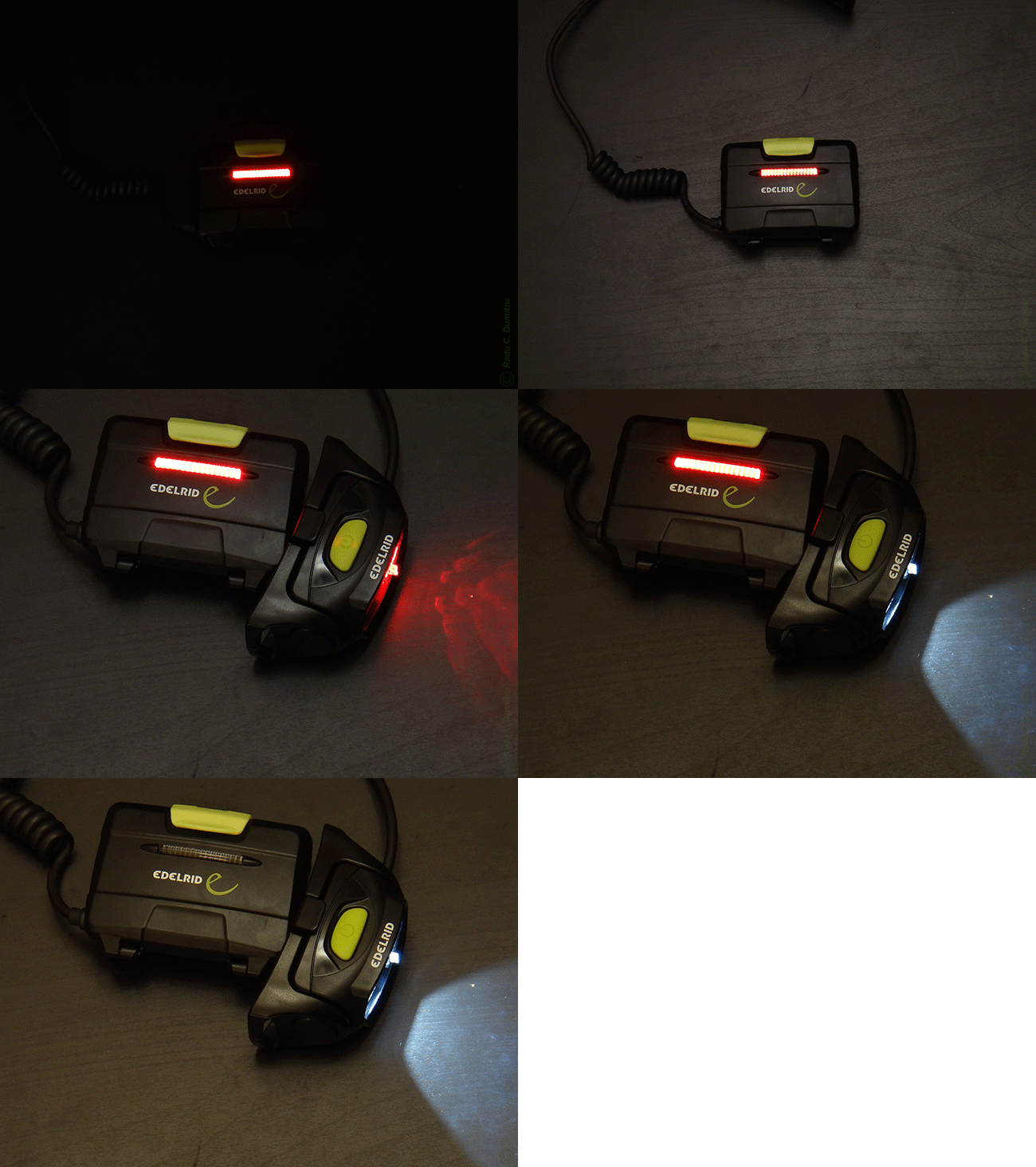
Basically we have two independent light switches: on front (white LED and red LED) and at the back (red LED). On the front side there are 3 modes for the main light - a white LED (20 lm, 110 lm, 250 lm) and a second red LED which can run on continuous or strobe mode. At the back, there is another LED inside the battery case that has it's own switch that can activate the LED on continuous or strobe mode.


The booklet is in all european languages:

The front side (the reflector) is 5 x 3 x 3 cm (wide, height, depth) mounted on a 8 x 3,5 cm (wide, height) structure that stays on the elastic strap. The reflector can be tilted from 0 (straight ahead) to about 50 degrees (downwards).

The plastic diffuser can be slided over the main LED light or the red LED near it. Taking the headlamp off the strap is very simple and useful for permanent mounting on a helmet. For that you'll need the optional Asteri Mounting Kit.
The back side consisting of the battery case is provided with another red LED with it's own switch. There are 3 modes for this red LED at the back: off, continuous and strobe. It's very useful probably in MTB, running or hiking in the night. Good that we can let it off.

Negative points:
- the plastic diffuser that is actually essential for a wide beam light is flimsy and you'll hear it bouncing all the time;
- the helmet mounting kit attachment system consist of a simple 3M tape like those on the GoPro's. While is tough enough for outside and occasional underground visits, caving with a headlamp fixed on helmet only with tape isn't the best idea.

The solution: drilling holes in the mounting kit like in the other caving systems solves the problem.
Here is the Asteri on an older helmet, mounted with screws. In front, I fixed the Helmet Mounting Kit with 2 small screws from inside the helmet to outside. I just cut the surplus of the remaining screw that went through the clip. After that I clipped the reflector easily, was made for that :). The battery case I managed to fix it with 4 small screws without the Mounting Kit. It can be done easily because the battery case have already 4 small holes filled by default with screws that keep the compartment attached to the strap clip. I just used those holes with longer screws that passed through helmet ABS, strap clip and battery compartment.

The best way to run the cable between battery case and lamp is through the helmet, not to let it outside where it can catch everything. The entire thing looks like it was made from the factory.

Burning time
I let the lamp on full power (rated at 250 lm)  with a stop watch near it. I measured with a photographic external light meter the exposure at a certain distance when the battery were new then I repeated the measurements after 5 hours. Becauase the intensity of the light of this headlamp is not regulated, the intensity of light will decrease while the battery get depleted. But, after 5 hours was still running strong, the difference between T0 and T+5 hours is less than an F-stop in photography. Which is like getting from ISO 200 to ISO 100. Visually speaking it lost about half of the power.
This is actually an impressive performance. So, the stated 13 hours of burning time might be a reality considering that all manufacturers don't want to follow a standard and they trick us by stating the burning time as being the duration between full power and the intensity of a candle at 2m. This is their "standard", a candle power they consider is enough to walk in the dark. You can read about all these here.

Well, how's the real light actually.
Let's let aside numbers for now, we are always slaves of numbers like is the only deciding factor. How about human factor, our own eyes, senses.
I simply took outside my main caving lamp: Petzl Ultra Vario and fired it on the medium setting which is rated at 200 lm (210 lm ANSI standard). This is also the mainly used mode in caving. I turned the Edelrid Asteri on full power (250 lm) and here we go:

The main differences, beside the fact that the Asteri shines over (due to the fact it had 50 lm more), is in the dissipation of light. The beam of Petzl is more fluent, almost natural. It covers corners of our sight very well (that's why I chose it). Then I got down on Earth: I just compared a 300 euros lamp over a 50 euros one. Period. Turning the Petzl on full power (520 lm) didn't made sense for a fair comparison.

Final thoughts
The Edelrid Asteri is a small technology wonder that is showing us where the LED technology is today powered only by regular batteries that you can find at your corner boutique, gas station or whatever store in a small village.

Now I have to retire my already old LedLenser H7 which in 2011 was a top notch masterpiece at 160 lm. The Edelrid Asteri will be my next back-up light and the main light for some of my colleagues.

Higher resolution pictures are here.

Friday, July 21, 2017

The new PETZL caving lights are coming in 2018


Finally, the upgrade for Ultra Vario caving helmet and also DUO are coming.
Their new names are: DUO S for Li-Io version and DUO Z2 for battery version.


In recent years the actual DUO (14 led) has been forgotten, eclipsed by the ULTRA, Scurion, ESPELEO or alike. How can anyone buy a 67 lm headlamp for caving in 2017 ? The design was a
refference but the technology inside it is more than 10 years old.


The new lights are a substitude for both Ultra Vario / Rush and DUO.
So, there will be no future Ultra line, but the new DUO instead.


Till now only positive things:

- same Accu 2 as Ultra (released in the 2010), Ultra Wide (released in the 2011), Ultra Rush (released in 2014) and Ultra Vario (realesed in 2014). A logic movement. So you can use your "old" Accu 2
- smaller, on a PIXA 3 like chasis.
- more powerfull (forget about marketing 1100 lm on boost) at 700 lumens (compared with 520 lm of Ultra Vario).
- longer burning time due to new LED technology improvement.
- same helmet mouting system so  you can just clip the new DUO S on your "old" Spelios, Trios or whatever other helmet you chose that have the Ultra mounting kit on it.

On the Z2 side, also only good news:
- it will run on normal AA (4 of them) battery that you can get anywhere. A big plus.
- 220 lm is a HUGE improvement over the existing 67 lm of the DUO.


The only question now is what price range. Normally the DUO Z2 should be in DUO price range (100 euros) while DUO S should be in the Ultra Vario price range (300 euros). Hopefully not more.

Tuesday, May 26, 2015

Salomon Quest 4D si garantia romaneasca


Dupa 10 luni de utilizare, perechea mea de Salomon Quest 4D da rateuri. Mi s-au dezlipit ambele talpi la calcai. Nu e bai, imi zic.
M-am dus cu ghetele la Salomon Romania ca am garantie 2 ani. Firma serioasa, mare. Si, dupa 14 zile am primit si raspunsul constatator: "Produsul prezinta talpile dezlipite datorita uzurii excesive. Uzura nu este acoperita de garantie. In dorinta de a sprijini clientul se incearca remedierea defectiunii reclamate." 
Au remediat problema lipind pur si simplu talpa la loc. Atat. Aici sunt poze dupa "remedierea" problemei.

Cam asa arata "uzura excesiva" a talpilor unui produs garantat doi ani:


E o cadere de zile mari la incaltamintea Salomon ce am folosit-o si in trecut si ma lasa dupa 3-4 ani....consumatorismul e la putere. Calitatea nu mai conteaza.
Problema cea mai mare este ca in .ro nici nu contezi. Practic se considera ca "ai stricat" ghetele ca le-ai folosit. Mare diferenta de atitudine intre dealerii din tara si cei de prin vest. Partea buna e ca putem proba in .ro o pereche pe care ulterior o poti achiziona din tari normale care chiar iti ofera garantie. Partea trista e ca aici e tara ta.
Am facut sesizare si la ANPC avand pastrate factura si chitanta. Ce n-am avut au fost poze cu talpile inainte ca baietii destepti de la Salomon Romania sa le lipeasca. Raspunsul ANPC a venit in 45 de zile: Nu pot expertiza procesul in cauza si imi recomanda "intelegerea amiabila" cu magazinul. Cel mai probabil lipsa pozelor inainte de lipitura a pecetluit soarta garantiei. Vina mea clar. Pur si simplu nu credeam ca se pune vreo problema la ditamai brandul sa nu le schimbe. Dar sa le lipeasca mah ?!! Sa lipeasca talpile la capul de gama al ghetelor Salomon.
Cu asta am incheiat subiectul Salomon Romania. Nu m-au mai tinut nervii sa scriu toata mizeria in engleza la firma mama. Importatorul in .ro se numeste MasterSport SRL care mai au magazinul Ascent, Sportsworld si MountainOutlet.
In ultimul an, din fericire pentru noi, magazinele de afara trimit si in tara gratuit daca treci de o anumita suma la comenzi. Ramane doar problema probatului la distribuitorii din .ro. Apoi, de garantie, nici nu se pune problema. Exemplu: frontala speologica Petzl Ultra Wide ce mi s-a stricat dupa 1 an si 10 luni, garantia ei fiind de 3 ani. Am scris aici despre asta. Imi pot imagina ce discutii pline de suspans as fi avut cu importatorul Petzl Romania daca as fi cumparat-o de aici. Nu vreti sa stiti cum arata o frontala muncita in pesteri timp de aproape doi ani. Numai daca o puneam pe masa ma dadeau afara.

Friday, April 18, 2014

Petzl Ultra Vario review


My "old" Petzl Ultra Wide (read that review) died suddenly after a caving trip in Sura Mare cave. After that trip, I recharged all 3 accus that I had, to be ready for the next cave. I also replaced all four cheap Li-Ion Uniross 2000 mAh from inside of Accu 4 box with Sanyo unprotected 2600 mAh to get ready for the big expedition that took place at the end of august.

So, doing just a test at home playing with Ultra Wide, I found that the lamp wouldn't pas the first level of light no matter what. I let it rest untouched for a couple of days and tried it again. Same problem, it turned on only on low level. So, big problem !
The expedition started and I went to it with a borrowed Scurion 1500 from a friend, while my Petzl Ultra Wide I carried it as a camp light or backup wishing that the problem will solve by it's own. That didn't happend of course so once I got back home, I sent it to where I bought it from, Germany.
After 3 weeks I got an answer from the shop that I bought it telling me that the lamp can't be replaced because they don't manufacture it anymore so I had two options: full refund or getting one of the new models: Petzl Ultra Rush or Petzl Ultra Vario.
So, customer care works at Petzl ! My Ultra Wide was almost 2 years old, used in about 60 caving trips, burned a lot, got dirty and it has scratches all over. All those things that happend during underground explorations.
So, all I could say when they presented me the offer was WOW. Of course, I opted for a a brand new Ultra Vario which replace the Ultra Wide in the range of caving lamps from Petzl, while Ultra Rush is replacing the Ultra for outdoor activities like trail running etc.
It arrived in february due to the fact that it wasn't available on stock before New Year, so I went back to my old Petzl 14 led till then. Patience was the key :)
And finally it came in a beautiful brand new box.
What I got was:
- the lamp itself
- an Accu 2 with the new 2600 mAh accus inside
- head strap
- helmet mounting kit for Vertex and Alveo helmets
- recharger for accu
- booklet
- a small cover
- IP 67
- a small sticker
...and of course 3 years guarantee from Petzl from the date of purchase !

So, technically I just upgraded for free from Ultra Wide to Ultra Vario free of charge.
Chapeau to Petzl customer care !

Mounting it on my helmet which is not a Petzl was same thing like it was with Ultra Wide because I still had the helmet mounting kit that I got it together with the Wide. Same dimensions, same design, just different colors: Wide was black-orange, Vario is black-yellow. The accu's from Wide were also orange while the new ones are grey.
Inside the box of the accu's, also a difference: the new accu's have 2600 mAh instead of 2000 mAh. Beside those things, these lamps are exactlly the same.
The light of Ultra Vario is almost perfect for caving. Why almost and not perfect ? Well...

The positive side
First of all, it has a very bright spot light which the old Ultra doesn't had. It is also brighter allround over the old model (520 lm vs 300 lm).
The charger provided with the lamp is sturdier, the cable is higher quality than the old one.

The levels of power:
On the lowest level, it looks brighter that Petzl Duo 14 LED, even if the light is rated at just 45 lm compared with 67 lm of Petzl Duo 14 LED. The beam is narrower than that of the Ultra Wide. I suppose that happend because they used just two LEDs which also with the dissipation pattern in front of them, aren't enough to spread the light at 180* like Ultra Wide did. I could say that the spread angle is about 160*.

On the 2nd level the level of light is enough for walking around and even taking pictures or filming. In this mode, the two LEDs that are also burning on the lowest level, became 5 time more brighter so it gives 200 lm with same beam of about 160*.

On the 3rd level, the light is shining all over, till a distance of 65 meters. You really can see everything and have to be carefull not to speak with your mates face to face on this level of light :). In this mode, beside the two LEDs that shine on 1st and 2nd level of light, a 3rd LED turns on that throw a spot light in the middle of the wide light generated from the the other two LEDs. This mode deliver the full 520 lm power.

The 4th level, is reserved  for pure spot light, very powerfull and deep. You can see far, very far. They say 210m. In this mode, only the narrow beam of the 3rd LED is burning at an intensity at least double the intensity that it lights up when on level 3. The light in this mode is rated 330 lm.

Interesting is also the fact that there are two ratings of power, one according to Petzl standard and one according to ANSI standard:

 So, in ANSI standard, we are talking about 604 lm of power.


On the negative side, compared with Petzl Ultra Wide, the beam of the light is narrower especially on vertical axis. On the horizontal axis the beam is still narrower with about 10* than the angle of beam light of the Ultra Wide. On the 3rd level, which deliver the full power of this lamp (520 lm) doesn't really matter that the angle is narrower than on Ultra Wide because there is plenty of light that is reflecting back also from walls, in normal passages.
Burning time with my custom made Accu 2 that uses 2 Sanyo Li-Ion 2600 Ah (read my full Ultra Wide review) lasted 6 hours and 30 minutes using mostly level 2 of power. That makes me think that also the LED's improved a lot over the old ones, because this burning time is awesome. After these 6h30m, the lamp switched to reserve mode for another 30 minutes but I didn't counted till the accu depleted because I switched the lamp off.
Petzl also came down on Earth about accus warranty. Instead of 3 years like they mentioned on the old accus boxes, now they offer just 1 year for the accu which I think it's fair enough. For the headlamp you are covered still 3 years which is also fair.

So, how does the caves looks while using this lamp ?
Well, you can rediscover caves that you thought you know before. It make you want to go to your roots to review your well known passages and chambers. This is the first Petzl lamp that can stand near big boss, Scurion. And this is a good thing, because the competition between several manufacturers bring prices down, give us chances to pick a caving lamp not only for the number of lumens that it gave, but also design, quality, weight, simplicity and not last, the feeling and personality of our lights that are so important for exploration of the mighty darkness of our Mother Earth.
For me, Petzl Ultra Vario was born as a winner, despide the minor problem with narrow beam on vertical axis which should be improved in the next generation of Ultra. Ideal, even it's a utopic word, should be a combination of the wide flood delivered by Ultra Wide and the spot of Ultra Vario. That's what I'll call a perfect caving lamp. Time will tell.